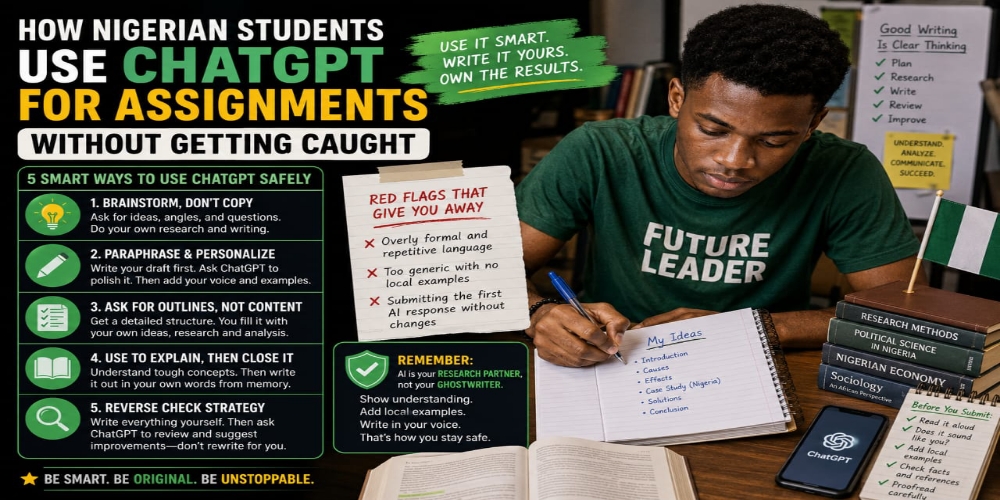
Let me start with the truth. Lecturers are not stupid.
Many of them have already caught students who copy and paste directly from ChatGPT. Some departments now run assignments through AI detection software. The days of typing a question and submitting whatever the AI spits out are over.
But here is what nobody tells you. There is a smart way to use ChatGPT that actually makes you a better student without putting your results at risk.
I have used these methods throughout my final year and not once did any lecturer question my work. The secret is not about hiding. It is about using AI as a research partner rather than a cheat code.
Why Lecturers Catch Lazy ChatGPT Users
Before I show you the methods, understand what gives people away.
First, ChatGPT has a certain writing style. It uses words like “delve,” “crucial,” “furthermore,” and “in conclusion” too often. It structures every paragraph in a predictable pattern. When a 200 level student suddenly starts writing like a professor, it raises eyebrows.
Second, the content is usually too generic. ChatGPT draws from broad internet knowledge. It rarely includes specific Nigerian examples, local case studies, or references to your department’s course material.
Third, lazy users submit the first response. They do not fact check. They do not rearrange. They do not inject personal opinion. So the work reads like a Wikipedia summary with no human touch.
Once you understand these three red flags, avoiding them becomes straightforward.
Method 1: Use ChatGPT as a Brainstorming Partner
Do not ask ChatGPT to write your essay. Ask it to help you think.
For example, if your topic is “The Effect of Social Media on Nigerian Youth Political Participation,” do not paste the whole topic and ask for an essay. Instead, ask something like this:
“What are 5 angles I can explore on how social media influenced Nigerian youth during the 2023 elections?”
ChatGPT will give you angles. You pick the ones that interest you. Then you research those angles yourself. Now the ideas are yours. ChatGPT only pointed you in a direction.
This method leaves zero AI footprint because you are still doing the actual writing and research. You are just working faster and smarter.
Method 2: The Paraphrase and Personalize Technique
This is the method that saved me the most. Follow these three steps:
- Step one. Do your own reading first. Open your textbook, lecture notes, or a credible article. Understand the concept yourself.
- Step two. Write your understanding in your own rough words. It does not have to be perfect. Just get your thoughts down.
- Step three. Paste your rough draft into ChatGPT with this prompt: “Polish this paragraph for clarity and academic tone, but keep it simple and natural. Do not add new ideas.”
What ChatGPT gives back will sound better structured but still contain your original ideas. Go through it and change any word that does not sound like you. Add a personal example. The final output sounds like an improved version of you, not a robot pretending to be you.
Method 3: Ask for Outlines, Not Content
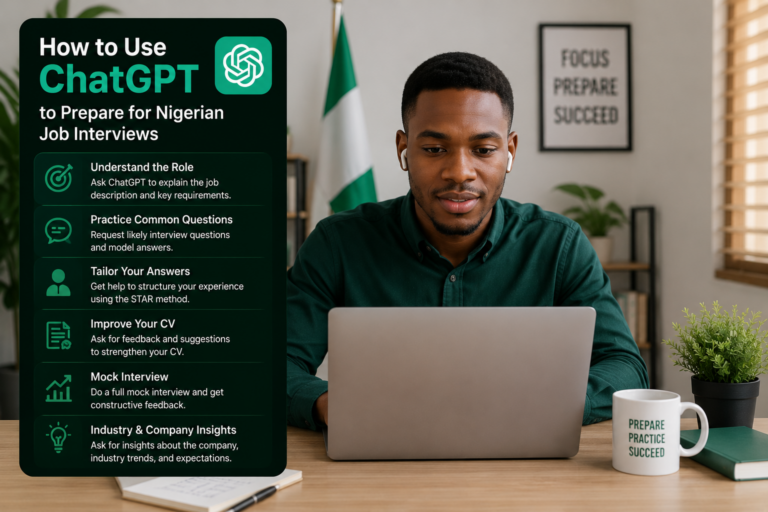
This is the safest approach for major projects and seminar papers. When you get a broad topic, do not ask ChatGPT to write anything. Ask for a detailed outline.
For instance: “Give me a detailed outline for a 2000 word seminar paper on the challenges of small businesses in Nigeria. Structure it with introduction, main points, and conclusion.”
ChatGPT will give you a logical structure. Section headings. Sub points under each section. Now you have a skeleton. You fill each section with your own reading, your own examples, and your own analysis.
The structure came from AI. The substance came from you. No detection tool can flag that because the actual writing is human.
Method 4: Use ChatGPT to Explain, Then Close It
This works for difficult courses where the textbook makes no sense. Open ChatGPT, paste the confusing paragraph from your textbook, and ask:
“Explain this in very simple English with an everyday example.”
Read the explanation until you understand. Close ChatGPT. Wait 30 minutes. Now write the concept in your own words without looking at any screen.
If you can explain it without help, you have genuinely learned it. That self written explanation goes into your assignment. It passes as fully original because it is.
Method 5: The Reverse Check Strategy
This is my personal favourite. Write your assignment completely by yourself first. Finish the whole thing. Then go to ChatGPT and paste your completed work. Ask it this:
“Review this assignment for clarity and logical flow. Point out weak arguments but do not rewrite anything.”
ChatGPT will highlight where your argument is unclear or where you need more evidence. You note the feedback. You go back and strengthen those parts with your own brain.
In the end, AI only served as a reviewer. The content remained yours from start to finish.
What No One Admits
Many lecturers know students use AI. They are not against the technology itself. They are against laziness disguised as intelligence.
If your work shows genuine understanding, specific examples, and a personal voice, most lecturers will not care how you arrived at the final draft. The problem starts when there is no evidence that you learned anything.
I have submitted assignments where ChatGPT helped me brainstorm and structure my thoughts. But because I added local examples, cited Nigerian authors, and wrote in my natural tone, nobody ever flagged anything.
One Final Practical Tip
Before submitting any work, read it aloud to yourself. Does it sound like something you would say in a conversation? If it sounds stiff, unnatural, or like a textbook wrote it, rewrite those parts.
Your lecturer knows how you speak in class. Your writing should not sound like a completely different person suddenly possessed you during assignment week.
Use these methods responsibly. AI is a powerful learning tool when handled well. Just do not let it replace the part of education that actually matters which is your ability to think, analyze, and communicate independently.