Nigerian job interviews are different. The questions follow patterns that are specific to how Nigerian employers think. The expectations around salary negotiation, body language, and even religious greetings vary from what international interview guides teach.
If you search for interview tips online, most results are written for American or British job seekers. They will tell you about behavioural questions and STAR methods. They will not tell you how to answer when an interviewer asks about your church or mosque, how to explain employment gaps caused by ASUU strikes, or how to handle the classic question about where you see yourself in five years when the Nigerian economy makes five-year planning feel impossible.
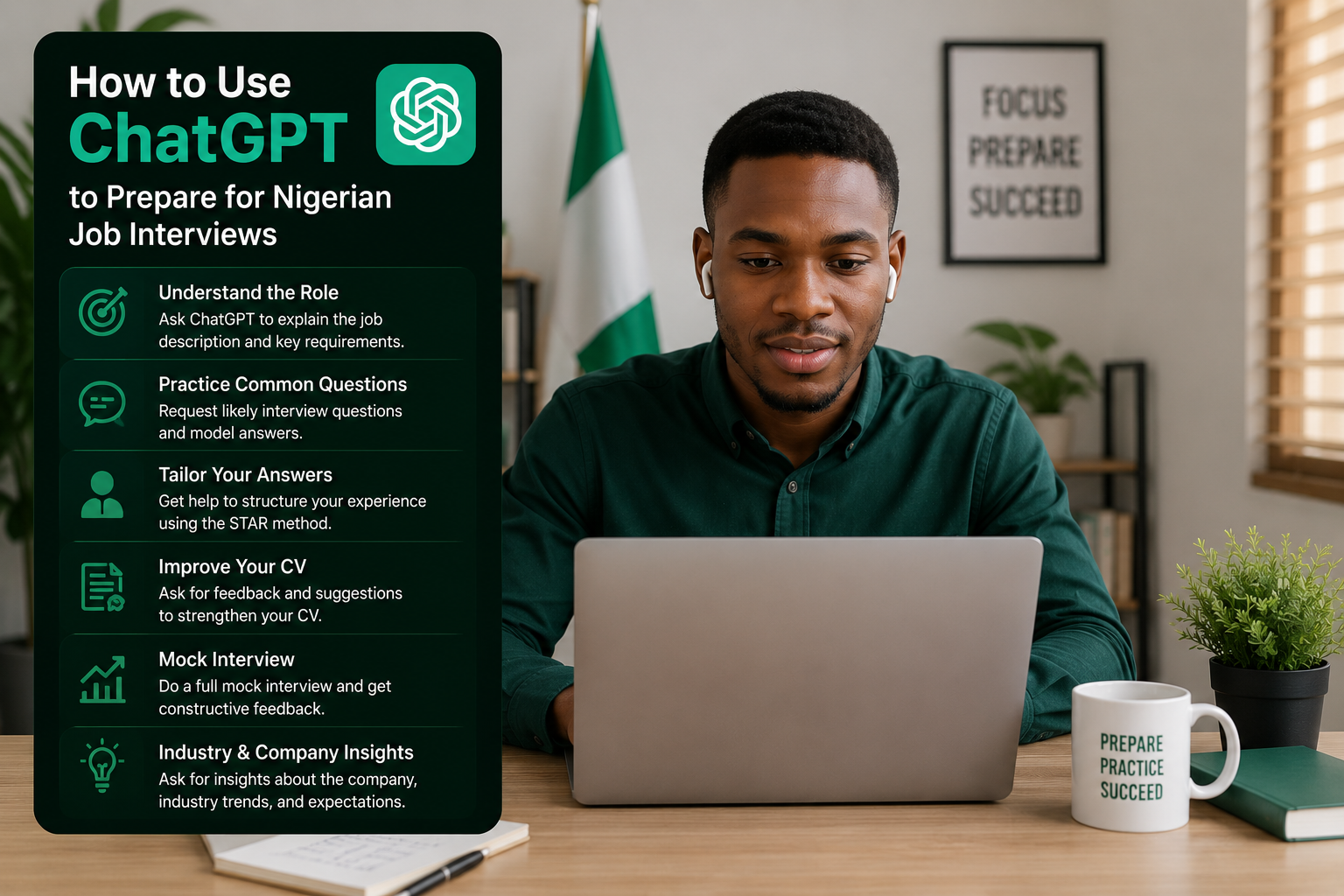
ChatGPT can help you prepare for Nigerian-specific interviews if you prompt it correctly. This guide shows you exactly how.
Why ChatGPT Works for Nigerian Interview Preparation
ChatGPT can simulate an interviewer. You can practice answering questions and receive feedback on your responses. You can do this at any hour without scheduling with a human. You can repeat difficult questions until you feel confident.
ChatGPT can help you research companies. It can suggest questions you should ask the interviewer based on the company and role. It can help you understand industry terms you might encounter.
ChatGPT can review your CV and suggest improvements that highlight the strengths Nigerian employers care about. It can help you craft responses that address common concerns like gaps in employment history or frequent job changes.
The key is telling ChatGPT the Nigerian context. Generic prompts produce generic advice. Specific prompts about Nigerian interviews produce useful, relevant preparation.
Step 1: Research the Company and Role
Before practicing interview questions, understand who you are interviewing with and what they want.
Open ChatGPT and use this prompt:
“I have an interview with a Nigerian bank for a graduate trainee position. The bank is one of the top five commercial banks in Nigeria. Help me research what this bank likely values in candidates and what I should know before the interview. Include information about their recent initiatives, their corporate culture, and common questions they ask.”
ChatGPT will generate a useful overview. It will not have the most recent news but it will give you a framework. Supplement this by visiting the bank’s website and reading recent news articles about them.
Next, use this prompt:
“Based on the job description for this graduate trainee role at a Nigerian bank, what specific skills and experiences should I emphasize in my answers? The job description mentions teamwork, analytical skills, and customer service orientation.”
ChatGPT will analyze the keywords and suggest which parts of your background to highlight. This preparation makes your answers more targeted than generic responses.
Step 2: Prepare for Common Nigerian Interview Questions
Nigerian interviewers ask questions that are different from Western interview scripts. Here are prompts to practice the specific questions you are likely to encounter.
For the classic Nigerian opener:
“I am preparing for a job interview in Nigeria. The interviewer will likely ask me to introduce myself. Help me craft a 60-second introduction that highlights my education, relevant experience, and why I am interested in this role. Make it professional but not robotic.”
For questions about your background:
“Nigerian interviewers often ask about where you are from and your family background. How should I answer these questions professionally without revealing unnecessary personal information?”
For the inevitable salary question:
“Nigerian employers often ask about current salary and salary expectations during interviews. Help me prepare diplomatic answers that avoid giving a number too early while not sounding evasive.”
For employment gaps:
“I have an employment gap because of the ASUU strike during my university years and also a period after NYSC when I was job hunting and upskilling. Help me explain these gaps positively in an interview setting.”
For questions about religion and personal life:
“Some Nigerian interviewers ask about your church or mosque, your marital status, or your plans for marriage and children. These questions make me uncomfortable. Help me prepare polite answers that maintain boundaries without offending the interviewer.”
For the five-year question:
“In Nigeria’s unpredictable economy, how should I answer the question about where I see myself in five years? I want to sound ambitious but realistic.”
For questions about leaving your current job:
“I am leaving my current job because of poor management and salary delays. When the interviewer asks why I want to leave, how do I answer honestly without badmouthing my current employer?”
Practice each answer out loud. ChatGPT gives you the words. You need to deliver them naturally. Speaking the answers helps you find your own voice.
Step 3: Simulate a Full Interview
Once you have prepared individual answers, run a full simulation.
Use this prompt:
“I want you to act as a Nigerian hiring manager interviewing me for a marketing role at a Lagos-based fintech company. Ask me typical Nigerian interview questions one at a time. Wait for my answer before asking the next question. At the end of the interview, give me feedback on my answers. Start with your first question.”
ChatGPT will begin the simulation. Answer each question as if you are in the real interview. Type your answers. After the simulation, review the feedback and note which answers need improvement.
Run this simulation multiple times. Each time, your answers become smoother and more confident. The nervousness that comes from not knowing what to expect decreases with each practice round.
Step 4: Prepare Questions to Ask the Interviewer
Asking good questions signals engagement and intelligence. Prepare questions specific to the Nigerian context.
Use this prompt:
“Help me prepare questions to ask the interviewer at the end of my interview for a role at a Nigerian company. I want questions that show I have done my research and am thinking seriously about the role. Include questions about company culture, career growth, and the challenges facing their industry in Nigeria.”
ChatGPT will generate a list. Select three to five that genuinely interest you. Do not ask questions just to impress. Ask because you actually want to know the answers.
Nigerian-specific questions might include asking about how the company navigated recent economic challenges, how the team collaborates across different Nigerian offices, or what growth opportunities look like for someone in this role over the next few years.
Step 5: Handle Post-Interview Follow-Up
The interview does not end when you leave the room. Follow-up matters.
Use this prompt:
“Help me draft a professional thank-you email after a job interview with a Nigerian company. The interview went well but there was one question about my technical skills that I feel I could have answered better. Include a way to briefly address that without sounding defensive.”
ChatGPT will draft a template. Customize it with specific details from your interview before sending.
Common Nigerian Interview Scenarios to Practice
Panel interviews are common in Nigeria. Practice being questioned by multiple people.
Use this prompt:
“Simulate a panel interview for a banking role in Nigeria. Have three different interviewers ask me questions from different angles. One should focus on technical skills, one on behavioural questions, and one on cultural fit.”
Aptitude tests often precede interviews. While ChatGPT cannot administer live tests, it can help you prepare.
Use this prompt:
“Help me prepare for a Nigerian bank aptitude test. What topics are typically covered? Give me practice questions on quantitative reasoning, verbal reasoning, and logical reasoning similar to what Nigerian banks use.”
Second and third round interviews get more intense. Practice for these separately.
Use this prompt:
“I have advanced to a second-round interview with the head of department. How do second-round questions differ from first-round questions in Nigerian companies? Help me prepare for more in-depth and strategic discussions.”
What ChatGPT Cannot Do
ChatGPT cannot predict exactly what your interviewer will ask. Use it to build confidence and preparation, not to script every word.
ChatGPT cannot read non-verbal cues. Nigerian interviewers pay attention to body language, eye contact, and the respect shown through greetings and demeanour. Practice in front of a mirror or record yourself to improve these non-verbal elements.
ChatGPT cannot guarantee results. The best prepared candidate sometimes does not get the job for reasons beyond their control. Preparation improves your odds. It does not eliminate competition.
Physical Interview Preparation
Beyond ChatGPT practice, several physical preparations improve your performance.
Dress appropriately for the company culture. Nigerian corporate environments generally expect formal attire. When in doubt, overdress rather than underdress.
Arrive early. Lagos traffic is not an acceptable excuse for lateness. Plan to arrive thirty minutes before your scheduled time.
Bring physical copies of your documents. CV, certificates, and identification. Even if you submitted them online, have printed copies in a neat folder.
Greet respectfully. Nigerian interviewers notice how you greet. Stand when they enter if you are seated. Use appropriate titles. Show deference without grovelling.
The Night Before the Interview
Use ChatGPT one final time:
“Help me do a final review before my job interview tomorrow. Ask me the five most important questions I should be ready to answer. After each question, give me one tip for delivering a strong answer.”
This quick session reinforces your preparation without overwhelming you with new information. Then close the app. Get sleep. Eat breakfast. Arrive early. Breathe.
You have prepared thoroughly for the Nigerian-specific realities of this interview. Walk in knowing you have done the work. Answer honestly. Be yourself. The preparation gives you confidence. The authenticity makes that confidence convincing.