As the 2027 general elections approach, Nigerian voters are faced with a critical question: what does each political party actually stand for? Beyond the campaign rallies, catchy slogans, and social media buzz, understanding the policy platforms of the major parties is essential for making an informed choice. The All Progressives Congress has secured President Bola Tinubu’s nomination for a second term, but they are facing a fragmented but determined opposition that includes several major blocs. This comparison breaks down the policy positions and political realities of the key players in the 2027 race.
The Major Players in 2027
The opposition to the APC is currently split across six major blocs, creating a complex political landscape. These include the NDC with Peter Obi and Rabiu Musa Kwankwaso, which has strong support among youth and in the North-Central and North-West regions. The ADC, featuring Atiku Abubakar and Rotimi Amaechi, has a broad national network but is often seen as representing the “old guard” of Nigerian politics. Other blocs include Governor Makinde’s APM faction with state-level strength in the South-West, the policy-focused but low-grassroots SDP, the ideological PRP in parts of the North, and the activist-driven Action Alliance led by Omoyele Sowore.
The APC’s Policy Platform
The APC, under President Bola Tinubu’s leadership, is campaigning on a platform of continuity and reform. The party’s core policies focus on economic expansion, industrialization, energy security, infrastructure development, and food security. Since taking office, the Tinubu administration has implemented significant economic measures, including the removal of fuel subsidies and exchange rate reforms, which are aimed at improving macroeconomic stability and boosting investor confidence. The administration also highlights investments in key infrastructure, including transportation, electricity, housing, irrigation, and digital connectivity.
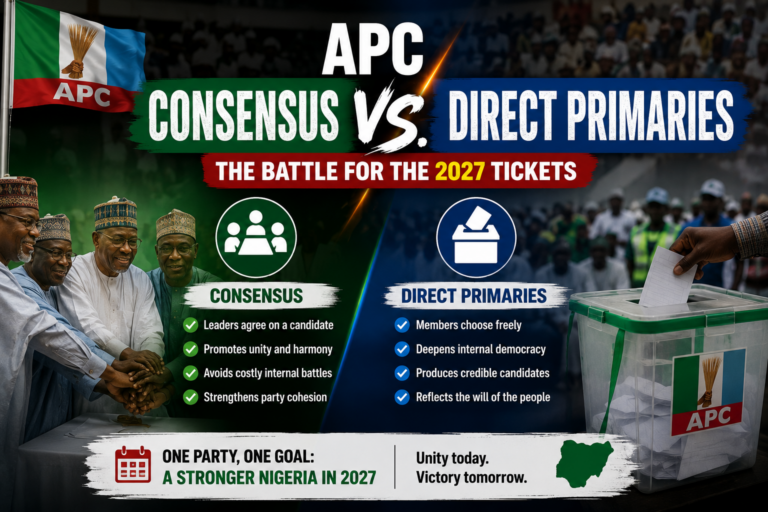
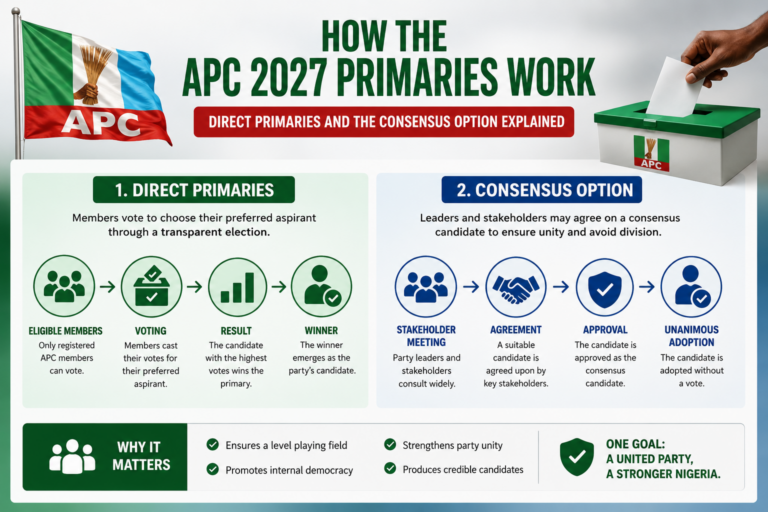
President Tinubu received more than 10.9 million votes in the APC primary, defeating his sole challenger, Stanley Osifo, in a direct primary that allowed registered party members to vote across the country. The party has taken the position that its economic reforms are necessary for long-term growth, despite the short-term hardships Nigerians have faced.
The Opposition’s Policy Proposals
The opposition parties, while fragmented, have outlined areas of agreement on what they would do differently if elected. A key theme is the need for a “reset” on three national priorities: power, security, and jobs. Many opposition leaders argue that the APC has failed to deliver on these critical areas despite its promises.
Specific proposals that have been floated by various opposition blocs include:
Power Sector Reform: A plan to achieve 6,000MW of effective power within 24 months, addressing one of Nigeria’s most persistent challenges.
Security Overhaul: The creation of a unified Homeland Security command within 12 months to tackle the country’s security challenges.
Job Creation: A target of creating 2 million jobs annually through investments in agro-processing, technology, and the creative sectors.
Economic Accountability: A commitment to convert 15% of Foreign Direct Investment (FDI) commitments into real investment and to publish a quarterly public scorecard on jobs and wages.
The Fragmentation Problem
The biggest challenge facing the opposition is its fragmentation. Political analysts warn that if all six blocs run separately, the APC could win with only 35-38% of the votes, even with widespread economic dissatisfaction. The voters see coalitions as elite deals, not real change, and there is no shared plan among the opposition groups. The election will likely be decided by the state of the economy, security, and whether the opposition can form a viable coalition.
What This Means for Nigerian Voters
For Nigerian voters, the choice in 2027 is becoming clearer. The APC offers continuity with its ongoing economic reforms, while the opposition offers a change in approach, particularly on power, security, and jobs. However, the opposition’s ability to deliver on these promises is complicated by their current disunity. Voters will ultimately decide whether to give the APC more time to implement its reforms or to take a chance on a fragmented but potentially more responsive opposition. The key is to look beyond the personality and evaluate the plans. The election will be won state by state, but trust is won with a plan people can verify.
Frequently Asked Questions
1. What are the APC’s main policy promises for the 2027 elections?
The APC is promising to continue its economic reforms, including the removal of fuel subsidies and exchange rate reforms, to improve macroeconomic stability. They also highlight investments in infrastructure, energy security, and food security.
2. Who are the major opposition candidates for 2027?
The major opposition blocs include Peter Obi of the NDC, Atiku Abubakar of the ADC, Governor Makinde of the APM, Adewole of the SDP, Baba-Ahmed of the PRP, and Sowore of the Action Alliance. However, they are currently fragmented.
3. What are the opposition parties promising to do differently?
The opposition is promising a “reset” on power, security, and jobs. They have proposed achieving 6,000MW of effective power in 24 months, creating a unified Homeland Security command, and creating 2 million jobs annually.
4. Why is the opposition fragmented?
The opposition is split across six major blocs, each with different leaders and bases of support. There is no shared plan, and voters see potential coalitions as elite deals rather than genuine change.
5. Can the opposition win in 2027?
Political analysts say that if the opposition stays fragmented, the APC is likely to win. However, if two large blocs merge, it could become competitive. If all six unite, it could be winnable for the opposition.
6. How does the economy affect the 2027 election?
The economy is a key factor. If inflation drops below 12% and power improves before the election, the APC is likely to keep its advantage. If the economic situation worsens, the opposition could gain ground.